| Official Name: | Democratic and Popular Republic of Algeria |
| National Name: | Al Jumhuriyah al Jaza'iriyah ad Dimuqratiyah ash Shabiyah |
| Alternate Names: | Algérie; Al Jaza'ir |
| Monetary Units: | 1 franc (f) = 100 centimes (c). Beginning in 1964, 1 dinar (d) = 100 centimes (c). |
| Location: | Northern Africa; bordered by the Mediterranean Sea (north); Morocco and Western Sahara (west); Mauritania, Mali, and Niger (south); Libya and Tunisia (east). |
| History: | Algeria was a French colony until September 1958, when it became part of France. On July 3, 1962, Algeria gained independence from France. |
| Mineral Resources: | Iron ore, phosphates, lead, zinc, mercury, uranium. |
|
|
|
Gypsum (var. Desert Rose) Algeria Scott 710 70 centimes |
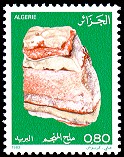
Halite Algeria Scott 711 80 centimes |
|
|
|
Quartz (var. Agate) Algeria Scott 712 1.20 dinar |
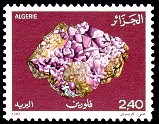
Fluorite Algeria Scott 713 2.40 dinar |
|
|
|
|
This set of 4 stamps was issued on 21 Apr 1983 and shows natural, unpolished mineral specimens. The agate shown on Scott 712 is likely sawed to reveal a cross-section of the specimen's internal structure. |
|
|
|
|
|
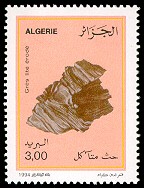
Sandstone (Gres lite erode) Algeria Scott 1029 3 dinar |
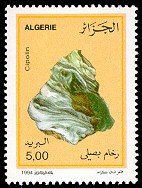
Marble (Cipolin) Algeria Scott 1030 5 dinar |
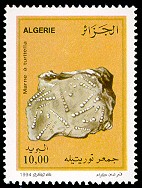
Sandstone (Marne a turitella) Algeria Scott 1031 10 dinar |
|
|
||
|
This set of 3 stamps was issued in 1994 and shows natural, unpolished rock specimens. Scott 1031 also shows exposed Turritella fossil shells. |
||
| http://mineralstamps.rbnet.net/alg.htm | Philatelic Mineralogy | Copyright © 1997-2010 by Richard Busch |